SYSTEM ROUTING / VALIDATION REPORT / 06 OCT 2026
Failures hidden in
shared hardware.
A hardware graph connects the fault you inject to the components you need to observe. Agents turn that context into an experiment. Simulators produce the evidence.
Illustrative board models with explicit assumptions. A separate follow-up exercises a native Autoware component. These are demonstrations of known mechanisms, not newly discovered production defects.
THE WORKFLOW
One prompt. A connected experiment.
Select a component and describe what to test. Its neighborhood supplies power, bus and clock connections, source anchors, and attached documents. Agents can also search and read the retained repository beyond those initial excerpts.
- Inspect
A scout reads the graph, documents and source, then proposes up to three useful tests.
- Challenge
A critic checks the source, existing protections, assumptions and whether the proposed measurements establish a meaningful failure.
- Plan & validate
A planner resolves concerns into one experiment. The service checks citations, graph bindings, controls, simulator capabilities and budgets.
- Run & save
The configured simulator explores parameters, checks properties and reduces failures. Results and replay artifacts are saved; agents stop after planning.
What the graph contributes
It identifies the components sharing a dependency and binds the disturbance to those exact components. In the controls below, changing a shared connection removes the failure. The simulator supplies the electrical or timing behavior; the graph supplies the wiring and the evidence to investigate it.
01 / SHARED VOLTAGE REFERENCE
Both sensors agree.
Both are wrong.
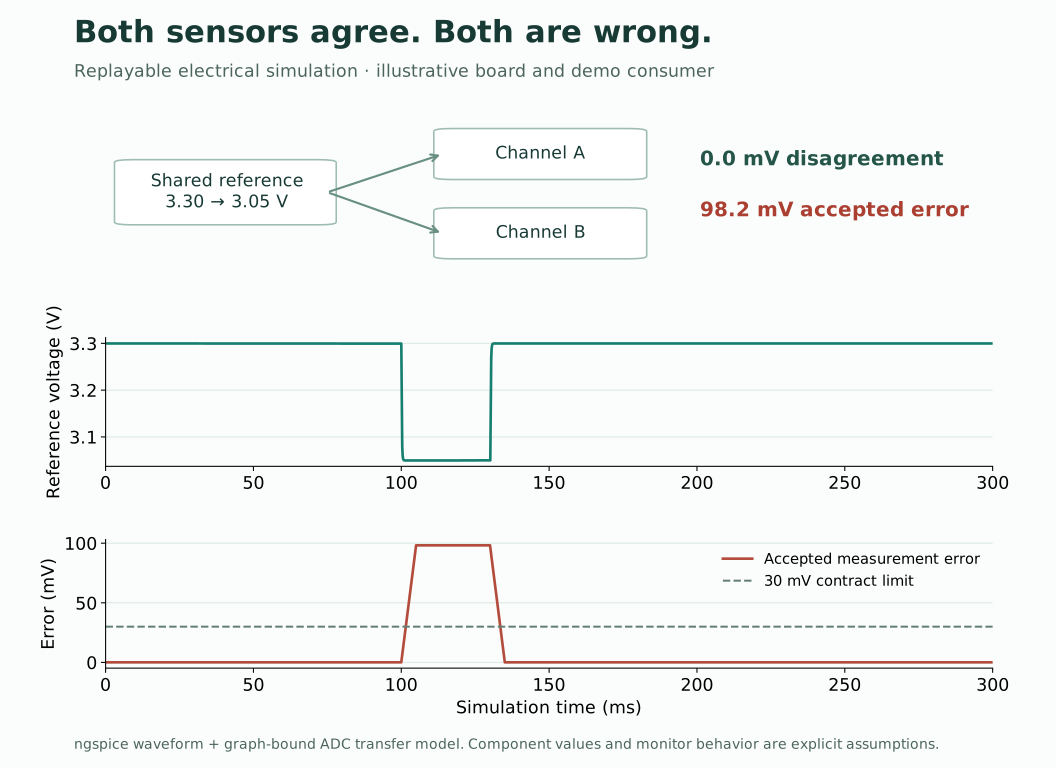
Two pressure channels pass their agreement check. Both ADCs share the same reference, so a brief voltage disturbance changes both conversion gains together. Comparing the channels cannot reveal their common error.
In the saved witness, the reference falls from approximately 3.30 V to 3.05 V. Each channel reports 1.2982 V for a 1.2 V physical input, exceeding the example’s assumed 30 mV accuracy limit.
What isolated the cause
An independent reference monitor, separate references, and ratiometric acquisition each removed the failure in the corresponding design control.
What ran
ngspice solved the reference circuit. Ideal ADC models fed a demonstration consumer that accepts agreeing readings. Board values and the consumer were authored for this example.
02 / SHARED SENSOR BUS
One device loses power.
Its neighbor goes silent.
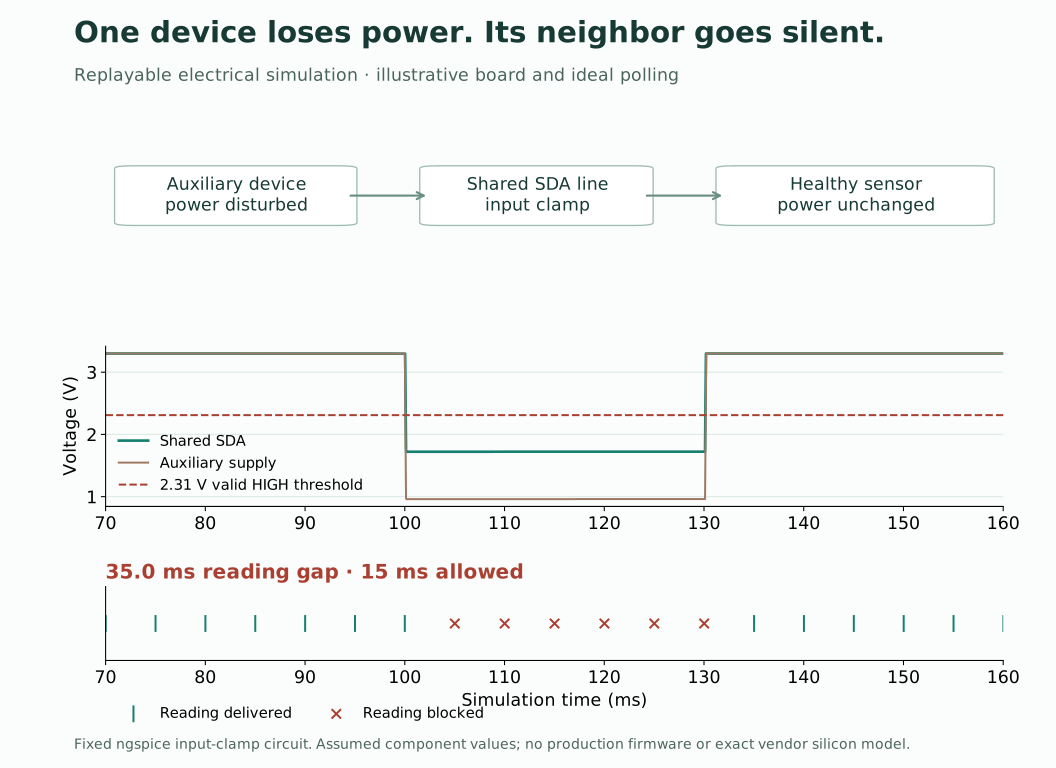
A healthy pressure sensor has its own supply, but shares an I2C line with an auxiliary sensor. When the auxiliary supply falls, its input protection loads that shared line. The healthy sensor remains powered and becomes unable to communicate.
The auxiliary rail drops to 2.374 V and the modeled SDA line reaches 1.72 V, below the board’s 2.31 V HIGH threshold. The graph’s bus connections determine which neighboring device receives the outage.
What isolated the cause
Powered-off high-impedance inputs, a separate bus, and neutral power each removed the failure. The healthy sensor must still produce successful readings to pass.
What ran
ngspice solved a diode/RC model of a released I2C line. Ideal polling turned unavailable HIGH levels into missing acquisitions. This does not model full I2C framing or firmware retries.
Follow-up: the outage reaches native Autoware
A separately configured 120 ms disturbance omitted 24 synthetic IMU acquisitions feeding an installed Autoware gyro-odometer 1.9.0. Across three runs, its twist output had a 124.98–125.01 ms gap. Neutral and high-impedance controls stayed around 6 ms.
Output headers were under 2 ms old when messages arrived. A check that only inspects received timestamps would miss the silence between them.
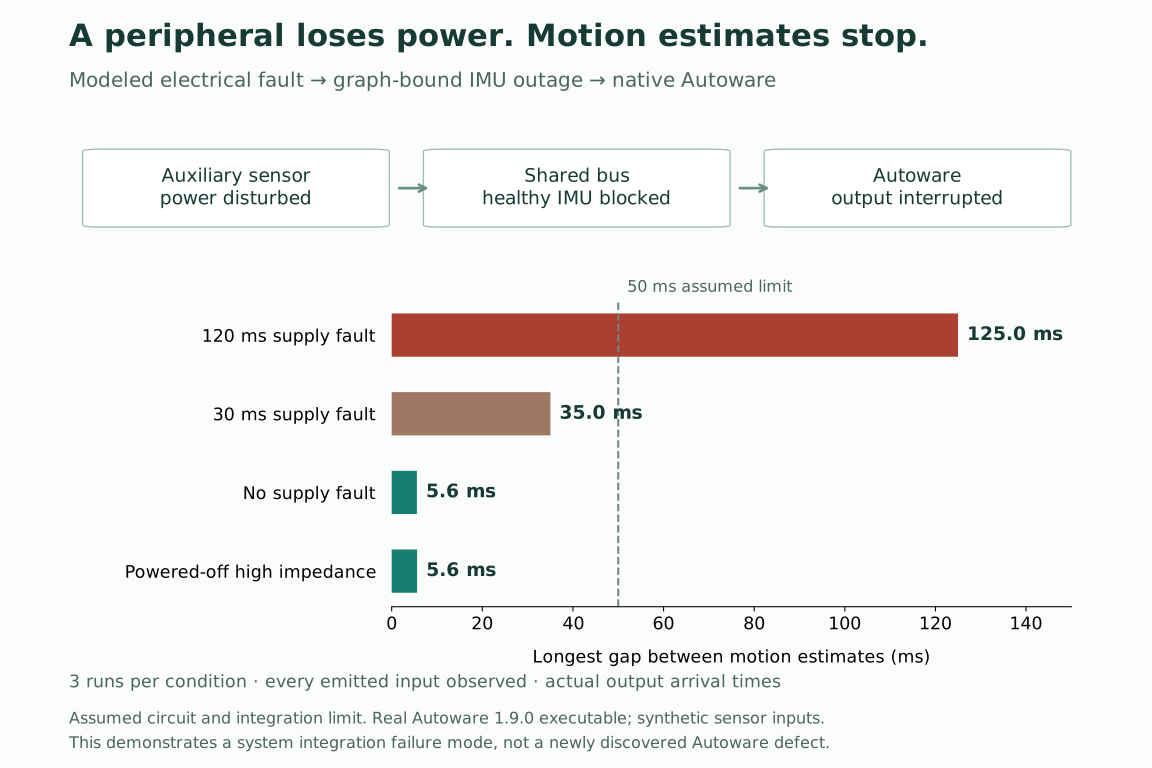
The 50 ms continuity requirement is an assumed integration contract. This follow-up was configured during development; it is not an agent-discovered Autoware defect or a physical vehicle test.
03 / SHARED WATCHDOG CLOCK
The watchdog slows down
with the system.
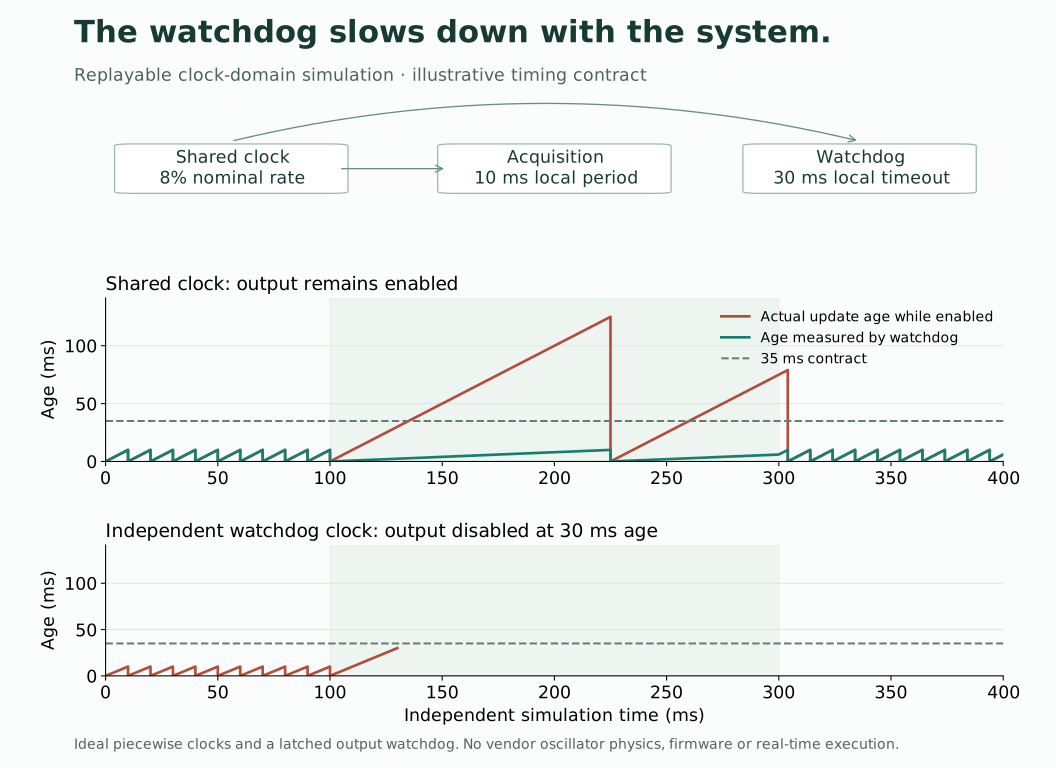
A watchdog checks acquisition updates using the same clock that drives acquisition. Slowing that clock stretches both the update period and the timeout. The independent observer sees aging data; the watchdog sees a normal cadence.
At 8% of nominal clock rate, a 10 ms local update period becomes 125 ms in independent simulation time. The 30 ms local watchdog timeout never fires, leaving output enabled beyond the example’s 35 ms age limit.
What isolated the cause
Changing one graph connection to an independent watchdog clock limits enabled-output age to 30 ms. Software stalls alone also trip the watchdog when its clock stays healthy.
What ran
A periodic producer and latched watchdog in explicit clock domains. The independent control assumes a separate output-disable path. It does not execute firmware or model oscillator physics.
CURRENT AGENT WORKFLOW
Three complete runs, with evidence retained.
The three figures above come from the original guided case studies. On October 6, the new scout → critic → planner workflow separately tested all three scenarios. Each actual Codex run received the same goal:
Explore useful stress tests for this illustrative system using the hardware graph, documented contracts and simulator source. This is an explicitly modeled demonstration. Use at most 12 cases.
| Scenario | Source requests | Failing / tested cases | Submit → saved result | Witness replay |
|---|---|---|---|---|
| Shared reference | 19 | 3 / 12 | 152.2 s | Exact |
| Shared bus | 17 | 3 / 12 | 163.6 s | Exact |
| Shared clock | 11 | 3 / 12 | 143.9 s | Exact |
These are three mechanisms, not nine bugs. Final campaigns had no runner errors or inconclusive cases. Timings include agent planning, repository requests, service validation, search and failure reduction. They exclude initial indexing and the separate manual replay check; this is not a comparative speed benchmark.
Was this all the agent?
The background agents inspected source, proposed and challenged tests, and generated the final experiment without loading the checked-in example specification. The service validated and executed it. Development supplied the illustrative boards, contracts, simulator models and original control variants. Documents and adapter descriptions still name known mechanisms, so these runs establish pipeline integration rather than blind discovery.
Earlier schema and validation failures were recorded and corrected. The saved plans were revalidated after those fixes. The critic also caught weak or correlated assertions before execution; its agreement is not a substitute for the service’s validation or simulator results.
Using this with another system
Import its graph, retain its repository, attach the relevant contracts, and configure an adapter exposing available controls and measurements. A graph alone cannot execute arbitrary software or reproduce physical behavior. The same service can validate plans for another adapter without embedding that repository’s failure cases into its core.